Oceania Taekwondo Union–World Taekwondo dispute: reported CAS appeals and election review
Emir Hamdan
September 24, 2026World Taekwondo (WT)Oceania Taekwondo UnionElections & AppointmentsDisciplinary Cases
Reported CAS appeals concern World Taekwondo’s response to a July OTU assembly, provisional suspensions and access to administrative systems. Primary records needed to assess both institutions’ actions remain unpublished.
Three appeals to the Court of Arbitration for Sport have been reported in the governance dispute between the Oceania Taekwondo Union and World Taekwondo. As of 24 September 2026, CAS had made no public announcement identifying an OTU–World Taekwondo proceeding and had published no ruling on the merits.
CAS does not announce every case, so the absence of a public record does not establish that no appeal was filed. The case numbers, parties, filing dates, jurisdictional basis, relief requested and procedural status remain publicly unconfirmed.
The available evidence is similarly incomplete on the actions taken by both institutions. The OTU Constitution and World Taekwondo’s disciplinary code establish the relevant procedural frameworks, but the complete July assembly record, World Taekwondo correspondence, provisional-suspension decisions and CAS filings have not been published. The validity or proportionality of either side’s actions therefore cannot be determined from the public record.
Published accounts say the appeals concern World Taekwondo’s refusal to recognise the outcome of an online OTU Extraordinary General Assembly held on 28 July; the provisional suspensions of senior vice-president Oh Jin Keun, secretary general Linda Pace and vice-president John Posing Cholai; and a directive for Pace to transfer access to administrative records, digital systems, financial accounts and communication channels.
OTU argues, according to those accounts, that World Taekwondo exceeded its sporting jurisdiction in matters involving an association incorporated under Victorian law. World Taekwondo maintains that the legal effect of OTU decisions under Australian law is separate from its authority to recognise officials and institutional acts within the international federation’s structure. Neither interpretation has been established by a published CAS ruling.
The dispute followed the OTU presidential election of 23 May 2025. Published accounts reported a 15–15 tie between incumbent John Kotsifas and challenger Maher Magableh, followed by questions concerning an American Samoa ballot and potential conflicts of interest. World Taekwondo invalidated the election and arranged a rerun for 29 September, which Magableh won.
A primary World Taekwondo notice issued before the rerun confirmed Kotsifas and Magableh as the presidential candidates. It said an ad-hoc investigation into OTU operations remained active and that relevant findings could affect continued participation in the election. The notice did not itself make a finding of wrongdoing against either candidate, and the investigation record underlying that statement has not been published.
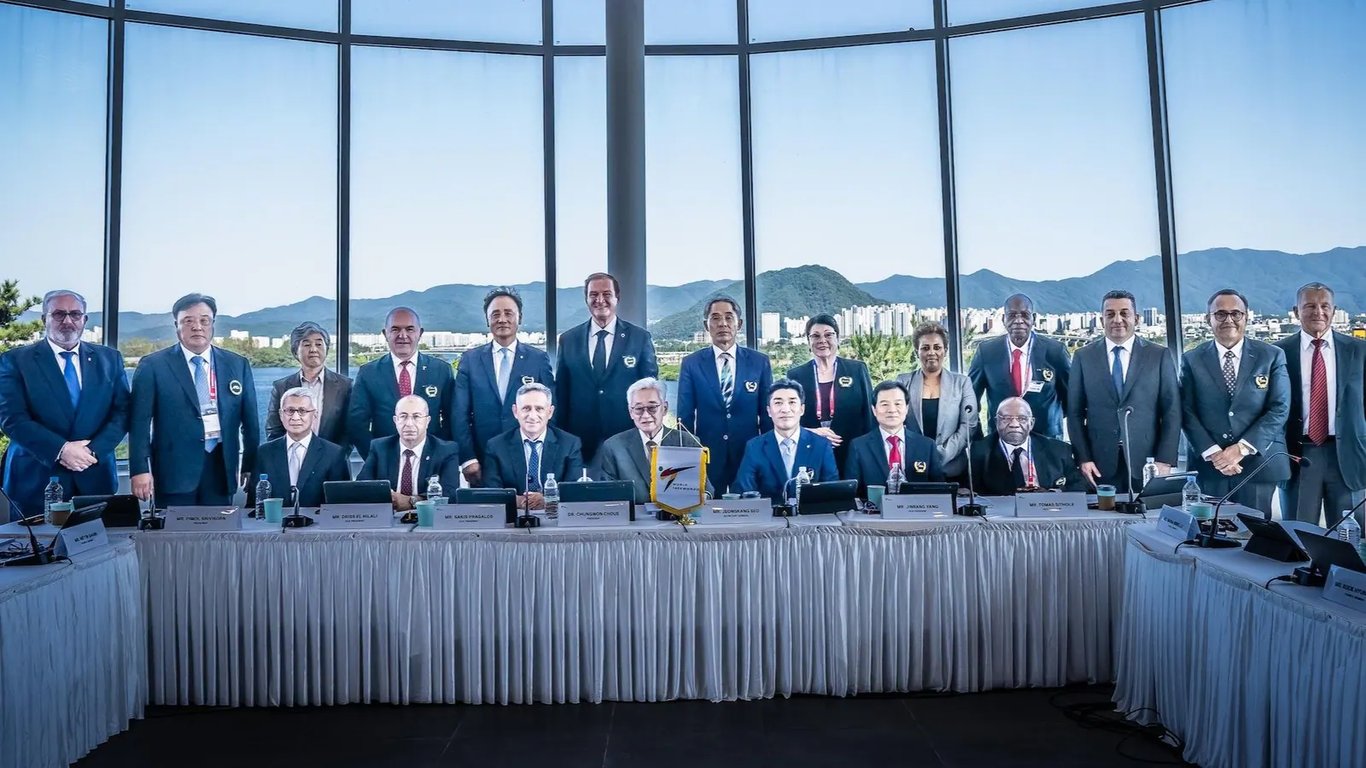
World Taekwondo and continental-union representatives at an elections and governance meeting in Seoul in March 2025.
According to published accounts of the 28 July 2026 assembly, the meeting voted 15–0, comprising seven Council members and eight member associations, for Magableh to stand aside temporarily and for Oh to exercise presidential powers on an interim basis. The resolutions were described as administrative measures connected to reputational concerns arising from public scrutiny of EzyMart, the business founded by Magableh, rather than findings of criminal or disciplinary wrongdoing.
The complete meeting notice, agenda, attendance and proxy records, voting audit and minutes have not been published. Article 5.1.2 of the OTU Constitution requires one month’s notice for an Extraordinary General Assembly, with the draft agenda and supporting documents circulated at least 14 days in advance. Without the assembly record, neither the reported vote nor compliance with those provisions can be independently established.
World Taekwondo declined to recognise the leadership change on 3 August and reportedly requested documents supporting the assembly’s validity. Published accounts attributed to the federation concerns about a calling notice circulated seven days before the meeting and differences among the recorded numbers of eligible voters, participants and votes cast. The complete correspondence and any supporting analysis have not been published, so the precise evidentiary and legal basis of World Taekwondo’s decision cannot be independently assessed.
World Taekwondo provisionally suspended Oh, Pace and Cholai on 7 August while investigations continued. The measures restricted their ability to act within the World Taekwondo framework but did not determine whether they retained office under Australian law. Provisional suspensions are not findings that the officials committed a breach.
Article 3.12 of World Taekwondo’s Disciplinary Actions and Appeals Code permits provisional measures during investigations into possible serious ethical misconduct or potentially irreparable harm. It requires reasons addressing the claimed harm, likelihood of success and balance of interests, together with a timeline and an internal appeal route. The complete decisions have not been published, preventing scrutiny of the allegations, evidence, reasoning, duration and procedural safeguards applied in each case.
The dispute also includes screenshots attributed to World Taekwondo secretary general Jeongkang Seo and Fadi Jaser Hussein. Published accounts describe exchanges concerning election strategy, communication with OTU Council members and the possible composition of an administration after the 2025 election. The complete conversation and original data have not been published or authenticated, and the screenshots alone do not establish improper institutional coordination.
Seo said he could not verify the screenshots’ authenticity, completeness or source and maintained that the World Taekwondo Council reached its decisions through formal procedures. Magableh said Hussein was a friend who provided voluntary support but held no formal campaign role and was not authorised to represent him to World Taekwondo. He denied directing electoral coordination with Seo or requesting sanctions against other officials. Kotsifas called for an independent investigation into the complete communications and related decision-making.
At its Extraordinary Council Meeting on 15 September, World Taekwondo was reported as saying that its Ethics and Juridical Committees would complete their review of the 2025 OTU election and submit findings to the Council. As of 24 September, no findings, underlying evidence or final decision from that review had been made public.
The unresolved questions apply to both sides of the dispute: whether the July assembly complied with the OTU Constitution; what evidence and reasoning supported World Taekwondo’s recognition decision and provisional measures; whether the reported appeals were registered and fall within CAS jurisdiction; and how authority under Victorian law relates to recognition within World Taekwondo. TAEKWONDO.TV will continue following the case as primary records or rulings clarify those questions.